Hamburg Financial Research Center

Finanzökonomisches Kompetenzzentrum und wissenschaftlicher Partner der Wirtschaft in der Metropolregion Hamburg.

News

Wir informieren fortlaufend zu den Aktivitäten und Neuerungen am HFRC über den Newsfeed unserer Institutsseite auf LinkedIn. Eine Übersicht der letzten Updates bieten wir zudem hier in der Rubrik News auf unserer Internetseite.

Shaping with AI - Deloitte x HFRC

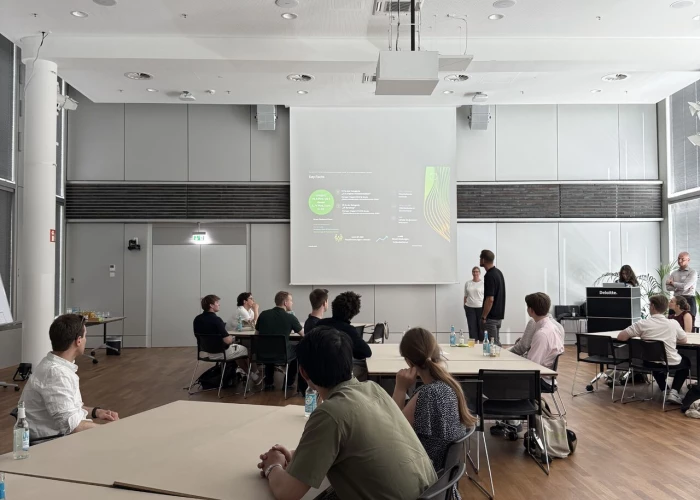
Last week, our HFRC Finance Talents had the opportunity to explore the growing role of artificial intelligence in business during an interactive workshop hosted by our corporate partner Deloitte.

Dr. Alexander Totzek and Maraike Ohlsen, MBA provided a concise overview of the latest AI trends and demonstrated how AI is already creating value across a wide range of industries.

In a hands-on case study, our Talents worked in teams to develop their own ideas on how AI can be applied along the value chain and received direct feedback from the Deloitte team. The evening concluded with a relaxed get-together over great food and drinks, offering plenty of opportunities for further discussions and networking.

Auf LinkedIn weiterlesen

Application Training & CV Check at Haspa

Yesterday, our HFRC Finance Talents had the opportunity to participate in an exclusive application training and CV review session hosted by Haspa | Hamburger Sparkasse at its headquarters in the Deutschlandhaus.

Together with Dr. Kamilla Zak and Hannah Staschen, our Talents were divided into two groups. One group received practical feedback on how to optimize their CVs and application documents, while the other took part in interactive exercises designed to strengthen communication and social skills for job interviews.

The evening concluded with a generous buffet and the opportunity to continue conversations, exchange experiences, and network in a relaxed atmosphere.

Auf LinkedIn weiterlesen

Launch of our new “HFRC Firetalks” series!

Yesterday, Dr. Christian Jasperneite (CIO of M.M.Warburg & CO and Founder of CAP2 GmbH) and Ulrich Müller (Member of the Executive Board at the Joachim Herz Stiftung) kicked off our new HFRC Firetalks event series.

Dr. Jasperneite spoke about how satellite-based remote sensing enables the global real-time monitoring of industrial processes and supply chains - from tracking competitors to estimating raw material production volumes.

Ulrich Müller shared insights into strategic foundation management, capital allocation, and the investment strategy of the Joachim Herz Foundation.

The evening concluded with pizza, drinks, and engaging discussions in a relaxed atmosphere - kindly sponsored by the Joachim Herz Foundation.

Auf LinkedIn weiterlesen

HFRC Spring Get Together 2026

What better way to welcome the warmer days than with good conversations, great drinks and familiar faces in the heart of Hamburg?

Last Wednesday our HFRC community came together for this year's Spring Get Together at The House in Grindelhof. In a relaxed and welcoming atmosphere, our Finance Talents, Alumni and friends of HFRC reconnected, exchanged ideas and made new connections over a truly enjoyable evening.

Auf LinkedIn weiterlesen

Review Hamburg Finance Forum 2026

Last week, the Hamburg Finance Forum 2026 marked the annual kickoff of the Hamburg Financial Research Center (HFRC), bringing together experts from academia, politics, and financial practice under the motto “Connecting minds to foster knowledge.”

The forum was opened by Dr. Andreas Dressel, Finance Senator of the Freie und Hansestadt Hamburg, highlighting the importance of strong capital markets for the financial hub Hamburg.

A key highlight was the keynote by Prof. Dr. Dr. h.c. Lars Feld, former Chair of the Sachverständigenrat zur Begutachtung der gesamtwirtschaftlichen Entwicklung, who provided an insightful economic policy perspective on investments in real estate and private infrastructure.

High-level panels and presentations on macroeconomic outlooks, fixed income, private markets and strategic asset allocation rounded off the program.

Speakers 2026 (in chronological order):
Prof. Dr. Wolfgang Drobetz, Dr. Andreas Dressel, Prof. Dr. Sebastian Heilmann, Prof. Dr. Henning Voepel, Dr. Martin Lück, Dr. Christian Jasperneite, Dr. Michael Ganske, CFA, Peter Herrmannsberger, Prof. Dr. Dr. h.c. Lars Feld, Andreas Meier, Dr. Dorothea Ringe, Dr. Adrian Presse, CAIA, Dr. Birka Benecke, Udo Meyer & Michael Busack.

We thank all speakers, participants and partners for the open and insightful exchange and look forward to continuing the dialogue between academia, politics, and financial practice beyond the Hamburg Finance Forum 2026.

CEE Group,T. Rowe Price Deutschland & Österreich, Berenberg, Ultramarin, Absolut Research GmbH, Joachim Herz Stiftung, FCH Finance City Hamburg GmbH
Auf LinkedIn weiterlesen

Hamburg Finance Forum 2026

The Hamburg Finance Forum traditionally marks the beginning of the year at the Hamburg Financial Research Center. Guided by our motto “Connecting minds to foster knowledge”, it convenes leading academics, institutional investors, and senior representatives from policy and the financial community for a high-level dialogue on the evolving landscape of institutional investing, combining research-based perspectives with real-world experience.

We look forward to welcoming you to the Patriotische Gesellschaft, just steps away from Hamburg’s Binnenalster, for inspiring discussions and meaningful exchange!

Auf LinkedIn weiterlesen

Publikationen

Wir veröffentlichen unsere Forschungsergebnisse regelmäßig in angesehenen internationalen Fachzeitschriften. Eine Übersicht aller Veröffentlichungen sowie der aktuellen Arbeits- und Diskussionpapiere bietet die Rubrik Publikationen.

Investor heterogeneity and venture performance

Marwin Mönkemeyer, Kathrin Rennertseder, Henning Schröder
Journal of Business Venturing | 09/2025
This study explores the link between investor heterogeneity represented on venture boards and firms' post-seed funding performance. We document a statistically and economically significant negative association of investor heterogeneity on both a firm's likelihood of obtaining new funding and the volume raised in new funding rounds. This suggest that investor heterogeneity decreases venture board efficacy and the quality of venture governance. The marginal impact of investor heterogeneity is non-linear and diminishing across a venture's funding life cycle. Our results remain robust after controlling for endogeneity issues and for alternative measures of investor culture.

Speculators and time series momentum in commodity futures markets

Björn Uhl
Review of Financial Economics | 02/2025
In this paper, we analyze the relationship between speculators in commodity futures markets and generic time series momentum (TSMOM) traders as well as the impact of this relationship on the subsequent TSMOM strategy performance. We find strong empirical evidence across all commodity markets that speculators in commodity markets tend to trade a TSMOM strategy, which confirms the results found by Boos and Grob (Journal of Financial Markets 64, 100774). On the basis of this result, we also ascertain whether the degree of such alignment has an impact on the performance of the TSMOM strategy. We find that there is weak, but statistically significant and robust evidence to suggest that the higher the degree of alignment between speculators and a generic TSMOM strategy, the lower the realized performance of trading TSMOM in these markets. Albeit we find little evidence that this can be exploited in a dynamic investment strategy, this negative relationship suggests that if a Commodity Trading Advisor (CTA) trades commodity futures markets which are less commonly traded by other CTAs, these markets may not only increase the internal diversification of their fund but these markets may also have a higher TSMOM Sharpe ratio by themselves. Consequently, our analysis provides valuable insights into improving the portfolio construction of CTAs.

Beyond ownership: The role of institutional investors in international corporate governance

Wolfgang Drobetz, Sadok El Ghoul, Omrane Guedhami, Xinya Yu
Corporate Governance: An International Review | 12/2024 | Forthcoming
Research Question/Issue: This paper reviews key theories on the governance role of institutional investors, examines institutional ownership trends globally, and highlights recent research on their evolving impact on corporate governance. The paper also incorporates insights from select Special Issue articles dedicated to understanding the role of institutional investors worldwide.Research Findings/Insights: We show that while most existing research focuses on the United States, recent evidence highlights significant global growth in institutional ownership. However, research examining the role of institutional investors outside the United States remains limited, despite some recent progress.Theoretical/Academic Implications: Institutional investors are increasingly shaping global capital markets and corporate governance through growing ownership, increased shareholder activism, and rising passive investment strategies. We provide recommendations for relevant topics to guide future research, including the governance preferences of institutional investors (i.e., voice vs. exit) across different investor types and international settings, as well as the collective influence of multiple institutional investors on corporate governance practices and outcomes.Practitioner/Policy Implications: There is a meaningful need for future studies to address the influence and effectiveness of institutional investors on corporate governance practices around the world. A better understanding of their role in different settings should improve their impact on corporations and, more broadly, on society.

Token-based crowdfunding: Investor choice and the optimal timing of initial coin offerings (ICOs)

Wolfgang Drobetz, Lars Hornuf, Paul P. Momtaz, Niclas Schermann
Entrepreneurship Theory and Practice | 06/2024
This paper examines the operating and financial performance of venture firms conducting initial coin offerings (ICOs) with different types of investors and at different points along a venture’s life-cycle. Relative to purely crowdfunded ICO ventures, institutional investor-backed ICO ventures exhibit weaker operating performance and fail earlier. However, conditional on survival, these ventures financially outperform their peers that do not receive institutional investor support. The diverging effects of investor backing on financial and operating performance are consistent with our theory of "certification exploitation" through a new form of pump-and-dump scheme. Institutional investors exploit their reputation to drive up ICO valuations and quickly exit the venture post-ICO, with the difference in pre- versus post-certification token prices being their exploitation profit in liquid markets for startups. Our findings further indicate that there is an inverted U-shaped relationship between the financial success of an ICO and the timing along a venture’s life-cycle, with the product piloting phase representing the pivotal point.

Events

Im Rahmen unserer Aktivitäten in Forschung, Wissenstransfers und Nachwuchsförderung organisieren wir verschiedene Veranstaltungsformate. Eine vollständige Übersicht unserer derzeit bereits terminierten Veranstaltungen bietet die Rubrik Events.

Forschung

HFRC Doctroal Course: Empirical Methods and Applications in Archival Data Research

02. bis 04. September 2026

Dieser Kurs richtet sich an Doktorandinnen und Doktoranden sowie Postdocs, die in ihrer Forschung empirisch arbeiten (v. a. mit Archivdaten, nicht mit Laborexperimenten). Ziel ist es, ein tiefergehendes Verständnis empirischer Methoden zu entwickeln und typische Fallstricke im Umgang mit ökonometrischen Schätzverfahren zu erkennen. Gerade bei der Analyse von Archivdaten ist die Auswahl und Anwendung geeigneter Identifikationsstrategien entscheidend, um belastbare und nachvollziehbare Ergebnisse zu erzielen.

Der Kurs behandelt zentrale methodische Herausforderungen, darunter Endogenitätsprobleme und weitere Fragen der statistischen Inferenz, die korrekte Anwendung und Interpretation von Fixed-Effects-Modellen sowie Differenz-von-Differenzen-Ansätzen (inklusive des Themas Standardfehler) und Instrumentalvariablen-Schätzungen. Die Teilnehmenden erhalten eine Vielzahl wissenschaftlicher Studien aus den Bereichen Accounting, Economics, Finance, Management und angewandte Ökonometrie, von denen die wichtigsten im Kurs behandelt werden. Zudem diskutieren sie exemplarische Forschungsarbeiten, die mit gängigen empirischen Methoden arbeiten, und üben deren kritische Bewertung. Neben der inhaltlichen Auseinandersetzung mit empirischen Designs steht auf Wunsch auch die praktische Anwendung im Vordergrund - unterstützt durch ein STATA-Handbuch und begleitende Übungen.

Der Kurs stärkt die methodische Sicherheit der Teilnehmenden im Umgang mit Daten und empirischen Ergebnissen - sowohl bei der Entwicklung eigener empirischer Studien als auch bei der kritischen Beurteilung bestehender Forschung. Die Teilnehmenden sollen befähigt werden, ihre empirischen Ansätze gezielt zu planen, methodisch zu begründen und gängige ökonometrische Verfahren angemessen in den jeweiligen Forschungskontext einzuordnen.

Der Kurs richtet sich an Promovierende und Postdocs verschiedenster Fachrichtungen, insbesondere aus den Bereichen Accounting, Economics, Finance, Governance sowie Management und Strategie. Grundkenntnisse in Statistik sind hilfreich, aber keine zwingende Voraussetzung. Weitere Informationen zu Inhalten und Ablauf finden sich im Syllabus. Die Kurssprache ist Englisch (wahlweise Deutsch, wenn alle Teilnehmenden dies wünschen).